
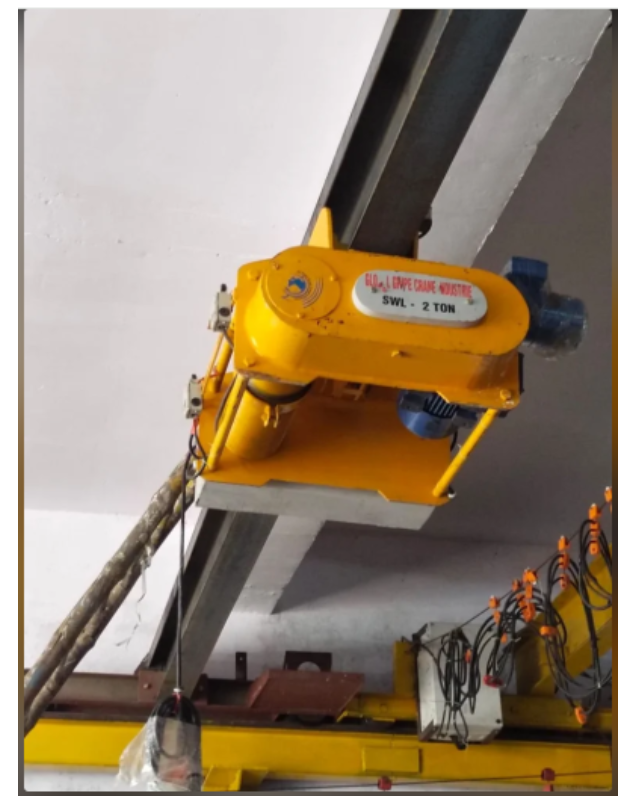
'EOT' stands for Electric Overhead Travelling crane. These are overhead cranes mounted on runways or rails inside or over industrial / production buildings that can travel longitudinally, and typically have a trolley/hoist that travels across the bridge girder to lift or lower loads. EOT cranes are common in factories, warehouses, power plants, steel mills, shipyards, rail shops, and other heavy‑material handling settings. Because of their heavy duty, complex mechanical & electrical systems, safety critical nature, and constant use, EOT cranes require systematic service and maintenance. Poorly maintained EOT cranes can lead to breakdowns, production delays, injuries, costly repairs, and reduced lifespan. Good service practices maximize uptime, safety, and return on investment. Single girder EOT cranes: one bridge girder, trolley + hoist suspended beneath or above, lighter duty, simpler design, lower headroom. Double girder EOT cranes: two bridge girders, more structural strength, higher lifting capacity and span, more complex, higher cost. Underslung / under‑running cranes: bridge suspended from roof structure, trolley and hoist travel on bottom flanges of girders. Variants with different controls: pendant, cabin, remote (wireless), etc. Hoist types: wire rope hoist, chain hoist; motors, gearboxes; speed configurations for hoist, long travel, cross travel.


This is your website preview.
Currently it only shows your basic business info. Start adding relevant business details such as description, images and products or services to gain your customers attention by using Boost 360 android app / iOS App / web portal.
Eot Crane Service In Noida
2025-10-15T05:03:10
'EOT' stands for Electric Overhead Travelling crane. These are overhead cranes mounted on runways or rails inside or over industrial / production buildings that can travel longitudinally, and typically have a trolley/hoist that travels across the bridge girder to lift or lower loads. EOT cranes are common in factories, warehouses, power plants, steel mills, shipyards, rail shops, and other heavy‑material handling settings. Because of their heavy duty, complex mechanical & electrical systems, safety critical nature, and constant use, EOT cranes require systematic service and maintenance. Poorly maintained EOT cranes can lead to breakdowns, production delays, injuries, costly repairs, and reduced lifespan. Good service practices maximize uptime, safety, and return on investment. Single girder EOT cranes: one bridge girder, trolley + hoist suspended beneath or above, lighter duty, simpler design, lower headroom. Double girder EOT cranes: two bridge girders, more structural strength, higher lifting capacity and span, more complex, higher cost. Underslung / under‑running cranes: bridge suspended from roof structure, trolley and hoist travel on bottom flanges of girders. Variants with different controls: pendant, cabin, remote (wireless), etc. Hoist types: wire rope hoist, chain hoist; motors, gearboxes; speed configurations for hoist, long travel, cross travel.
2025-10-15T05:03:10


Submit Your Enquiry